Posts

Slaves of the crucified Lord

Image
       Paul – the “slave” of Jesus (Rom. 1.1; Gal. 1.10) – showed us how to follow a crucified King.   His encounter with the Risen Lord on the Damascus Road marked Paul’s “crucifixion” (cf. Gal. 6.14) regarding the self-assertive ethos that had guided him up to that moment and his “resurrection” into a new life of self-emptying, obedient service to his crucified-and-risen master (cf. Phil. 2.5-7; 3.4-11).   Indeed, Paul’s autobiographical remarks in his letter to the Philippians showcase two kinds of apologetic strategy – on the one hand, Paul’s former apologia had involved him in the pursuit of intellectual brilliance, socially mobility and respectability, and what’s more – zeal to the point of using violence to defend the integrity of Jewish tradition, and, on the other, a strategy of downward mobility, accompanied by the loss of status, credibility and security, that was albeit no less zealous.   Only that, once he had been commissioned as an apos...
Some more thoughts on Acts chapter 2

Image
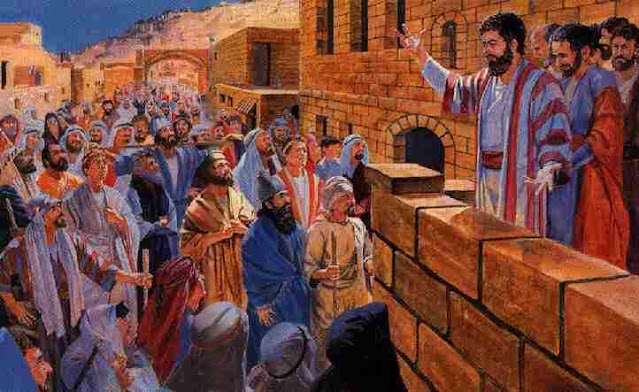
       Narrative patterns.   In Acts chapters 2—7, there is a repetitive “cycle” that plays out four times.   Each instance of this four-fold cycle consists of three elements – a miraculous event, a sermon and the “fallout” of the event-interpreted-by-the-sermon.   The first of the 4 cycles occurs in Acts chapter 2.   The first of the 3 typical elements (the miraculous event), consists of the disciples speaking in the various languages of the diaspora Jews that have gathered in Jerusalem (Ac. 2.1-13).      Miraculous event (speaking in tongues).   The Feast of “Pentecost” was an annual festival in Judaism commemorating the giving of the Law to Moses (celebrated on the “50 th Day” after Passover).   This time, as Luke points out, Pentecost has a prophetic dimension .   At Mt. Sinai, Moses had said: “Would that all the Lord’s people were prophets, and that the Lord would put his spirit on th...

Some thoughts on Acts, chapter 2

Image
       In chapters 2—5 of the book of Acts, the Galilean “Jesus-movement” takes Jerusalem by storm! (cf. Ac. 2.7).   In these opening chapters, we see the same pattern of “ministry” as had occurred in Galilee through the activities of Jesus and the disciples in Luke’s Gospel (= preaching and healings).   Compare this part of the book of Acts with Jesus’ “holy week” in Jerusalem (Lk. 20—23), which had been characterized by daily preaching in Temple, constant questioning by religious leaders, hostility from Temple leadership, the crowds serving as Jesus’ “bodyguard” and finally, Jesus’ arrest and trial.   In Luke’s Gospel, most of the action takes place in Galilee and involves the renewing of Israel through the 12 apostles.   In Luke’s sequel, the book of the Acts of the Apostles, the action begins where it had ended in his Gospel – in Jerusalem.   In volume 2 of Luke’s work, the renewed Israel grows, and prepares to renew the world. ...

Some thoughts on The Acts of the Apostles, chapter 1

Image
       Luke links his follow-up work with his Gospel, a.k.a. “the first book” (Ac. 1.1).   Luke tells his readers that during the 40 days following the resurrection, Jesus appeared to the apostles and spoke to them of “the kingdom of God” (Ac. 1.3; cf. 28.30-31); the theme of “the kingdom” forms “bookends” for the book of Acts.   The risen Jesus bequeaths to the disciples the promise of the Holy Spirit (Ac. 1.4-5; cf. Lk. 3.15-16; Ac. 11.16; 19.1-7).   John, the baptizer in water, had promised that the One coming after him would baptize in the Spirit.   The link between John the Baptist’s ministry and that of Jesus is an important theme in Luke-Acts; cf. Lk. 7.28-29; 9.18-19; 20.1-8; Ac. 1.22; 10.34-38; 13.23-25; 18.24-25; 19.1-7.      As Jesus gathers with the apostles on the Mount of Olives (where the Garden of Gethsemane was located), they ask him: “will you now restore the kingdom to Israel?” (Ac. 1.6; cf. Lk. 2.25-...

“Taking the time to teach/be taught”

Image
       How to integrate cultural apologetics into practical Christian ministry?   The pioneers of 20 th -century Christian apologetics used the latest mass media technology to evangelize and offer a rational defense of the faith.   In the U.S.A., Fulton Sheen (1895—1979) used radio and TV to expound/defend Roman Catholic Christianity from 1930—1968.   In the U.K., C.S. Lewis (1898—1963) argued for “mere Christianity” on the BBC radio from 1941—43 and offered both rational and imaginative defenses of Christian doctrine through the publication of numerous books.   The 21 st century has seen many apologetics ministries avail themselves of the power of the internet to defend the faith.   American Robert Barron (b. 1959) founded Word on Fire Catholic Ministries [1] at the turn of the third millennium.   Fr. Barron began his evangelistic efforts by delivering homilies on a Chicago-area radio station at 5 a.m. on Sundays.   His first aud...

Some thoughts on the Gospel of Matthew

Image
       Worship.   This is a recurrent theme in Matthew’s Gospel.   The magi “make obeisance” [1] to Jesus (2.11; cf. 2.2, 8).   During Jesus’ testing in the desert, Satan offers Jesus all the kingdoms of the world if he will “make obeisance” to him.   Jesus retorts that it is written that one should only make obeisance to God (4.9-10).   Various characters make obeisance to Jesus throughout the narrative – a leper (8.2), Jairus the ruler of the Capernaum synagogue (9.18), the disciples (14.33), a Canaanite woman (15.25), the mother of James and John (20.20), the women at the tomb on Easter morning (28.9) and other disciples that saw him after his resurrection (28.17).   Jesus is worthy of worship because he is “God with us” (1.23; 28.20).      The Devil.   Hart’s translation renders each Greek word that denotes “the Devil” differently in the desert temptation episode.   Jesus is led into the wilderness to...

Christianity & Islam: the early years

Image
       The 7 th century saw the former (united) Roman empire split into three entities – the “barbarian west” where Catholicism predominated, the Eastern Byzantine empire which was Orthodox, and the Muslim world which would soon stretch from Persia to Spain (south of Europe for the most part).   Christians in Muslim lands were dubbed “people of the Gospel” and were often obliged to pay the dhimmi tax.   It is not always easy to distinguish between the polemical caricatures of Muslims in Christian texts and historical reality.   Undoubtedly, there was sometimes religiously inspired violence against Christians in Muslim lands during this period, but there doesn’t seem to have been anything approximating “genocide” perpetrated against Christians once their lands had been conquered.   Three of the five historic Christian patriarchates – Jerusalem, Alexandria and Antioch – quickly fell into Muslim hands.      Indeed, it was...