Posts

A 40-DAY JOURNEY WITH THE KING: Lenten reflections from Mark’s Gospel (11)

Image
  “Again [Jesus] began to teach beside the sea. Such a very large crowd gathered around him that he got into a boat on the sea and sat there, while the whole crowd was beside the sea on the land.   He began to teach them many things in parables, and in his teaching he said to them: “Listen! A sower went out to sow...” (Mk. 4.1-3)      Though Mark has made it clear that Jesus is a teacher (1.21-22, 39; 2.1-2, 13; 3.20, 32ff), he has yet to give us a glimpse of the content of that teaching.   Finally, as chapter 4 opens, the wait is over.   Once again, Jesus is by the Sea of Galilee, teaching the crowds from the safety of a fishing boat (4.1; cf. 3.7-10).   As Jesus comes aboard the vessel, he adopts the typical posture of a teacher; i.e., he sits (4.1; cf. Mt. 5.1).   Hence the expression “to sit at the feet of a master” (cf. Lk. 10.39).   Jesus speaks “the word” to the crowds (2.2; 4.14ff, 33).   In Luke’s Gospel, t...

A 40-DAY JOURNEY WITH THE KING: Lenten reflections from Mark’s Gospel (10)

Image
  “Then [Jesus] went home;   and the crowd came together again, so that they could not even eat.   When his family heard it, they went out to restrain him, for people were saying, “He has gone out of his mind.”   And the scribes who came down from Jerusalem said, “He has Beelzebul, and by the ruler of the demons he casts out demons.” (Mk. 3.19b-22)      After a reprieve in chapter 2, the demons make a return in chapter 3.   After the confrontation with the Pharisees in the Capernaum synagogue (3.1-6), Jesus withdraws to the seaside as the ever-growing crowds of seekers-after-healing throng around him.   Jesus comes up with a strategy that will both take advantage of the topography and protect him from being trampled by those he seeks to help – he teaches the crowds from the safety of a fishing vessel floating a safe distance from the shore (3.7-10).   Jesus is like a magnet, drawing all who are sick and demon-possessed towards hi...

A 40-DAY JOURNEY WITH THE KING: Lenten reflections from Mark’s Gospel (9)

Image
  “[Jesus] answered, “Let us go on to the neighboring towns, so that I may proclaim the message there also; for that is what I came out to do.” And he went throughout Galilee, proclaiming the message in their synagogues and casting out demons.” (Mk. 1.38-39)      Preaching in the synagogues and casting out demons – or indeed, casting out demons in synagogues (cf. 1.21-28).   It’s an intriguing way to summarize what Jesus was doing as he walked around the villages of Galilee.   As a matter of fact, most New Testament scholars – even the skeptical ones – agree that Jesus had a reputation for being an exorcist.   Needless to say, Jesus had something of a habit of disrupting the sabbath routine in the synagogues he frequented (cf. 3.1-6).   As I read Mark’s narrative, I get the uneasy sense that had I been in attendance at a synagogue when Jesus made an appearance, I may indeed have taken the side of the Pharisees.   I mean, let’s be ...

A 40-DAY JOURNEY WITH THE KING: Lenten reflections from Mark’s Gospel (8)

Image
“Then [Jesus] said to them, “The sabbath was made for humankind, and not humankind for the sabbath;   so the Son of Man is lord even of the sabbath.” (Mk. 2.27-28)      Between two accounts of Jesus visiting the seaside to teach/heal the ever-present and ever-growing crowds (2.13; 3.7-12), Mark shows us the collision of Jesus’ vision of holiness with that of the Pharisees.   Mark accomplishes this by means of 4 short episodes, each of which contains a question that serves to reveal the underlying motives of these competing visions, the first three being asked by the Pharisees of Jesus/his disciples (concerning eating) and the fourth being asked by Jesus of his opponents (concerning the sabbath; cf. 2.6-9).   Jesus’ unconventional ways about the town of Capernaum now begin to make waves.      The third episode (2.23-28) has Jesus and his disciples walking through a grainfield on the sabbath.   The disciples, being hungry, be...

A 40-DAY JOURNEY WITH THE KING: Lenten reflections from Mark’s Gospel (7)

Image
“When the scribes of the Pharisees saw that he was eating with sinners and tax collectors, they said to his disciples, “Why does he eat with tax collectors and sinners?”   When Jesus heard this, he said to them, “Those who are well have no need of a physician, but those who are sick; I have come to call not the righteous but sinners.” (Mk. 2.16-17)      Between two accounts of Jesus visiting the seaside to teach/heal the ever-present and ever-growing crowds (2.13; 3.7-12), Mark shows us the collision of Jesus’ vision of holiness with that of the Pharisees.   Mark accomplishes this by means of 4 short episodes, each of which contains a question that serves to reveal the underlying motives of these competing visions, the first three being asked by the Pharisees of Jesus/his disciples (concerning eating) and the fourth being asked by Jesus of his opponents (concerning the sabbath; cf. 2.6-9).   Jesus’ unconventional ways about the town of Ca...

A 40-DAY JOURNEY WITH THE KING: Lenten reflections from Mark’s Gospel (6)

Image
  “…Jesus said to the paralytic, “Son, your sins are forgiven.”    Now some of the scribes were…questioning in their hearts,   “Why does this fellow speak in this way? It is blasphemy! Who can forgive sins but God alone?”    At once Jesus…said to them…Which is easier, to say to the paralytic, ‘Your sins are forgiven,’ or to say, ‘Stand up and take your mat and walk’?   But so that you may know that the Son of Man has authority on earth to forgive sins”—he said to the paralytic— “I say to you, stand up, take your mat and go to your home.” And he stood up, and immediately took the mat and went out before all of them; so that they were all amazed…” (Mk. 2.5-12)      Along with exorcisms and healings, there is another predominant theme in the first two chapters of Mark’s Gospel – the forgiveness of sins.   This had been the essence of John’s message (1.4-5).   Whether John’s preaching was the catalyst of what Mark ...

A 40-DAY JOURNEY WITH THE KING: Lenten reflections from Mark’s Gospel (5)

Image
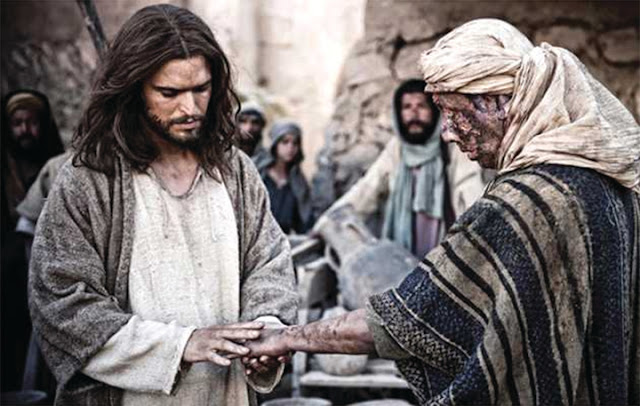
“A leper came to him begging him, and kneeling he said to him, “If you choose, you can make me clean .”   Moved with pity, Jesus stretched out his hand and touched him, and said to him, “I do choose. Be made clean !” Immediately the leprosy left him, and he was made clean .   (Mk. 1.40-42)      Along with exorcisms, Jesus performs many healings of various physical ailments in the early chapters of Mark’s Gospel.   Jesus’ first healing is that of Simon’s mother-in-law (1.29-31).   With the restoration of the leper, we begin to understand the meaning of Jesus’ healings (and exorcisms).   The thrice-repeated word “clean” in the above passage reveals what is truly going on when the King restores the members of the people of God to wholeness.   Leprosy rendered its victim “unclean”, i.e., it proscribed that person from participation in the life of the community, of both civil society and the worship/litur...