Posts

Mark's Gospel as Sequel: Understanding the Backstory, part VII (Isaiah)
Image
       To fully understand Mark’s “sequel” to the Scriptures of Israel, we need to look at 7 previous “episodes”, 7 OT characters who shed light on what Mark is saying about John the Baptist and Jesus in chapter 1.   The seventh character from the “original story” is Isaiah .      In our reflections on Jeremiah and Daniel, we have seen the importance of the exile in Babylon for our understanding of the New Testament Gospels.   Though the Babylonian exile had occurred during the 6 th -century B.C., there seems to have still been a lingering sense of a situation of “exile” even among those Jews living in the Holy Land at the time of Jesus.   Yes, they were back in the Land and there was a Temple in Jerusalem; however, their situation was fraught with ambiguity.   Take the Temple – the second National Shrine had originally paled in comparison with the one built by Solomon (cf. Ezra 3.12-13) and Herod the Great, the first-century...
Mark's Gospel as sequel: Understanding the backstory, part VI (Daniel)

Image
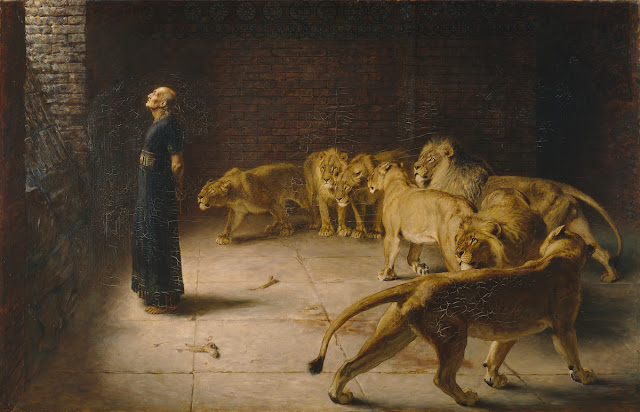
     To fully understand Mark’s “sequel” to the Scriptures of Israel, we need to look at 7 previous “episodes”, 7 OT characters who shed light on what Mark is saying about John the Baptist and Jesus in chapter 1.   The sixth character from the “original story” is Daniel .      As the story is told in the book that bears his name, Daniel was a member of the Jerusalem aristocracy and was part of the first wave of Babylonian deportations in 605 B.C., the fourth year of the reign of King Jehoiakim of Judah (cf. Dn. 1.1-6); further deportations would follow in 598 and finally in 587, when Jerusalem was sacked and the exile would begin for the majority of the Jerusalemite population.   As we saw last time, the prophet Jeremiah had foretold the disaster of 587 for 40 years and had declared that the subjects of the Kingdom of Judah would remain in exile for 70 years (cf. Jer. 25.11-12; 29.10).   In 539 B.C., the Babylonian empire fell to the P...

Mark's Gospel as Sequel: Understanding the Backstory, part V: Jeremiah

Image
       To fully understand Mark’s “sequel” to the Scriptures of Israel, we need to look at 7 previous “episodes”, 7 OT characters who shed light on what Mark is saying about John the Baptist and Jesus in chapter 1.   The fifth character from the “original story” is Jeremiah .      As we saw last time, Jesus’ message concerned the “kingdom of God” (Mk. 1.15).   In the Psalms, Yahweh is described as King of the world (Pss. 47, 93-99, etc.).   Yahweh, the King of the world, ruled the nations through his “son” enthroned in Zion (Ps. 2.6).   The dream of the Hebrew Scriptures is for Yahweh to establish his reign (kingdom) over the whole world, through his son/viceroy, the King of Israel – one world, one God.   The realization of this dream was guaranteed by the Davidic covenant recorded in 2 Sam. 7 – Yahweh’s promise that there would always be a descendant of David on the throne of Jerusalem.   However, at the time...

Mark's Gospel as sequel: Understanding the Backstory, part IV: David (2)

Image
       To fully understand Mark’s “sequel” to the Scriptures of Israel, we need to look at 7 previous “episodes”, 7 OT characters who shed light on what Mark is saying about John the Baptist and Jesus in chapter 1.   The third character from the “original story” is David .   In 2 Samuel 7.8-16, we have the story of the founding of the Davidic covenant – God’s promise that there would always be a descendant of David on the throne of Jerusalem, forever .   It repeats the key features of God’s covenant with Abraham, which “gave birth to” the people of God (cf. Gn. 12.1-3).   God promises David three things: a great name, that Israel will be “planted” securely (cf. Jer. 1.10) in the Promised Land, and an everlasting line of descendants upon his throne (2 Sam. 7.8-13).   The wider context – and play on words – is that David had recently expressed his desire to the prophet Nathan to construct a “house” (i.e., Temple) for Yahweh (2 Sm. 7.1-3). ...

Mark's Gospel as sequel: Understanding the backstory, part III: David (1)

Image
       From the very first verses of his Gospel, Mark plugs his story into the narrative of the Hebrew Scriptures (i.e., Old Testament).   Mark has written a story (Gospel) about a first-century Jew who lived in Northern Palestine (Galilee).   Mark is presenting the story of Jesus as the fulfillment of the story of Israel , which began in Gn. 12.1-3 with God’s calling of Abra(ha)m.   Abraham , Isaac, Jacob, Joseph, Moses and all the other OT characters were part of the “people of God” , the family that God promised to give to Abraham that would be God’s agent of salvation in the world.   God revealed his name ( Yahweh ) to Moses in Ex. 3.14, and as the Israelites gathered at the base of Mt. Sinai, Yahweh renewed and expanded the covenant that he had first established with Abraham (Ex. 19—20; cf. Gn. 12, 15, 17).   A covenant is a sacred agreement made between God and his people, with promises of blessing for faithfulness and curs...

Mark's Gospel as sequel: Understanding the Backstory, part II: Elijah

Image
       From the very first verses of his Gospel, Mark plugs his story into the narrative of the Hebrew Scriptures (i.e., Old Testament).   Mark has written a story (Gospel) about a first-century Jew who lived in Northern Palestine (Galilee).   Mark is presenting the story of Jesus as the fulfillment of the story of Israel , which began in Gn. 12.1-3 with God’s calling of Abra(ha)m.   Abraham , Isaac, Jacob, Joseph, Moses and all the other OT characters were part of the “people of God” , the family that God promised to give to Abraham that would be God’s agent of salvation in the world.   God revealed his name ( Yahweh ) to Moses in Ex. 3.14, and as the Israelites gathered at the base of Mt. Sinai, Yahweh renewed and expanded the covenant that he had first established with Abraham (Ex. 19—20; cf. Gn. 12, 15, 17).   A covenant is a sacred agreement made between God and his people, with promises of blessing for faithfulness and curs...

Mark's Gospel as sequel: Understanding the backstory, part I: Moses

Image
       From the very first verses of his Gospel, Mark plugs his story into the narrative of the Hebrew Scriptures (i.e., Old Testament).   Mark has written a story (Gospel) about a first-century Jew who lived in Northern Palestine (Galilee).   Mark is presenting the story of Jesus as the fulfillment of the story of Israel , which began in Gn. 12.1-3 with God’s calling of Abra(ha)m.   Abraham , Isaac, Jacob, Joseph, Moses and all the other OT characters were part of the “people of God” , the family that God promised to give to Abraham that would be God’s agent of salvation in the world.   God revealed his name ( Yahweh ) to Moses in Ex. 3.14, and as the Israelites gathered at the base of Mt. Sinai, Yahweh renewed and expanded the covenant that he had first established with Abraham (Ex. 19—20; cf. Gn. 12, 15, 17).   A covenant is a sacred agreement made between God and his people, with promises of blessing for faithfulness and curs...